Tech Week at ASU Gammage
By Sophie Pallissard
If you’ve ever wondered what happens before a Beyond show at ASU Gammage, picture this: a stage crowded with set pieces, cables, ladders, glowing consoles and a small army of people dressed head-to-toe in black. That’s Tech Week — the sacred, caffeine-powered rite of passage every production must survive before the audience sees the final magic.
One big difference between tech for a Broadway show and tech for a Beyond show is how self-contained Broadway tours are. When a touring production loads into the venue, they bring their own crew, sets and equipment. ASU Gammage’s staff is there to oversee the process. However, for a Beyond show, often featuring independent artists, the incredible ASU Gammage tech team gears up.
For an entire week, the tech crew works closely with the artist and creative team to shape the perfect performance. “All the equipment for a Beyond show is handled by us. It’s our staff running the sound booth for these performances,” explains Lisa Adamsen, one of ASU Gammage’s production managers.
While observing one tech session for Chris Rivas’ HOW TO GET FREE, I quickly realized how different lighting needs to be for a one-man show compared to a company of dancers. “These shows are very artist-dependent,” Lisa noted. “For Bill T. Jones, we rented 66 additional lighting units.”
No two Beyond productions share the same technical layout, and ASU Gammage occasionally premieres entirely new works. To meet these demands, members of the tech crew routinely work nearly 12-hour days, adjusting and refining elements until the show is ready.
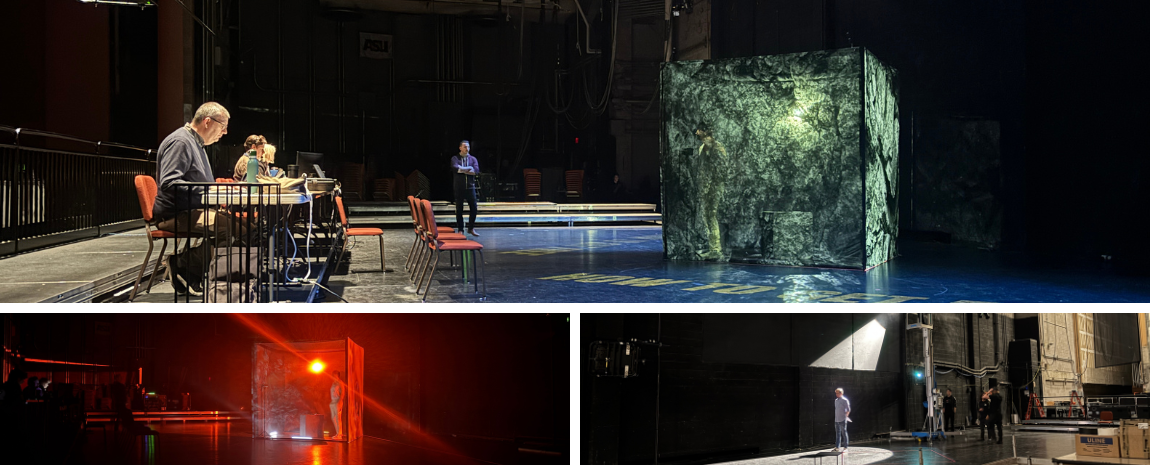
As lights were being hung, I looked around, wondering why Rivas was absent. Lisa explained that the morning would be a “dry tech” run: designers going cue by cue through the script, walking through the entire show without performers. It’s a skeletal version of the story, created so that once the actor steps onstage, the team can fine-tune details.
By the afternoon, the stage had darkened. The only illumination came from a custom-built box featuring Rivas. Brian Freeland, production and systems manager for HOW TO GET FREE, explained that the box was a new element developed after the show’s previews. ASU Gammage would be the first venue to feature it. Tech Week became even more essential: How would the box appear onstage? Were the angles correct? How would the projections land?
As these questions swirled in my mind, cues flew back and forth between the artist and the tech team. Everything from “Cut fire from that angle,” to “Chris, keep talking so we can get your audio.” Lines were trimmed, scenes reshaped. Everything remained fluid.
When opening night arrived, every late night, every lighting adjustment and every reworked cue fused into a seamless performance that audiences embraced with enthusiasm. What’s remarkable is that most people watching had no clue how much ingenuity, labor and heart went into shaping the experience they were enjoying. Tech Week’s greatest triumph is making the impossible look easy.
Tech Week at ASU Gammage isn’t just preparation. It’s transformation. None of it would be possible without the dedication of the tech team.