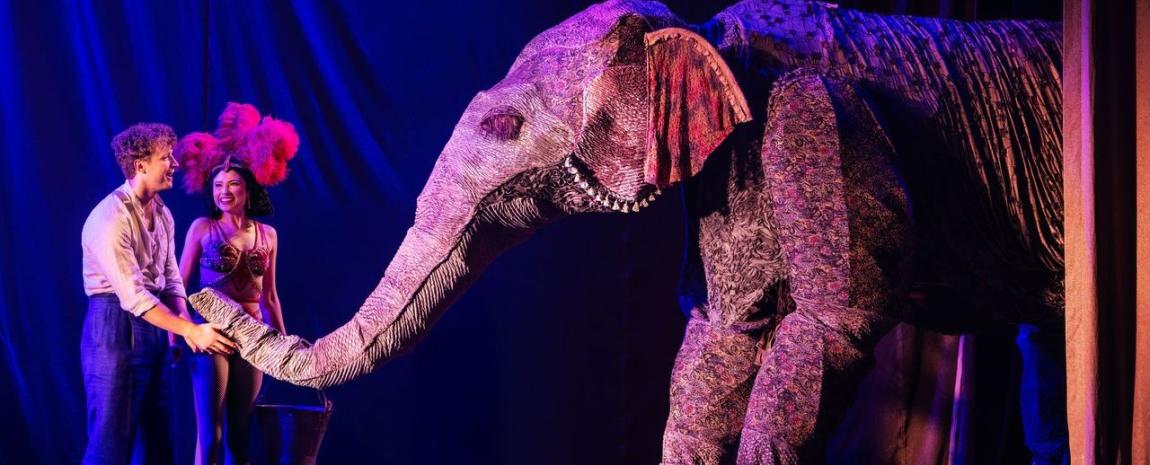
How WATER FOR ELEPHANTS The Broadway Musical Brings a 10-Foot Elephant and Menagerie of Other Creatures to Life
Long before Rosie the elephant takes her first steps across the stage in WATER FOR ELEPHANTS, audiences have already begun believing in magic. The breathtaking 10-foot-tall elephant—operated by three performers—is one of the production's most talked-about stars. But according to Puppet Director Joshua Holden, Rosie doesn't come alive because she moves. She comes alive because of the moments when she barely moves at all.
"It's a small shift in weight," Holden said. "Even getting these puppeteers to move just very slightly, all of a sudden you go, 'Whoa—that thing is alive.'"
Those subtle moments are the result of years of experimentation, collaboration and painstaking craftsmanship. Holden joined WATER FOR ELEPHANTS before it ever reached Broadway. Originally hired for just two days to help demonstrate how Rosie would function during an early workshop, he expected to return home once the presentation ended.
Instead, he unknowingly auditioned for a much larger role. "I was told, 'This isn't a job interview. We just need you to help make the elephant look good,'" Holden recalled.
As the show’s director worked through scenes with the puppet team, Holden naturally began translating between the creative vision and the technical language of puppetry.
"It became clear they didn't quite have the vocabulary to communicate with puppeteers," he said. "So, I would talk with the director, then turn to the puppeteers and say, 'Let's try this.'" After the workshop, Holden congratulated puppet designer Camille LaBar and wished her luck. "The producers had two things to say," LaBar later told him. "'They loved the puppet...and they wanted to know who you were.'"
Today, Holden serves as Puppet Director for the Broadway production and its national tour, overseeing a menagerie of nearly a dozen puppets that help bring the circus world to life. While Rosie may be the production's emotional centerpiece, she wasn't always part of a fully realized vision. "There were lots of changes," Holden said. "For the first production using these puppets, there were so many unknowns—how they were going to work, how they were going to look. Even during rehearsals we were constantly asking, 'Is this working?'"
Initially, Holden only knew about three animals—the elephant, a lion and a dog. The rest of the production's animal world evolved through workshops and rehearsals as the creative team discovered what best served the story. One of the show's most unforgettable creations is Silver Star, a horse represented by little more than a sculpted head and flowing mane. Because WATER FOR ELEPHANTS is told as an older character in the show looking back on his life, Holden said the puppets intentionally reflect the fragmented nature of memory. "The character remembers Silver Star's head and that beautiful mane, but the rest fades away," he explained. "The audience fills in the rest with their imagination."
Teaching dancers to become puppeteers
One of Holden's biggest challenges wasn't designing the puppets; it was teaching performers with completely different backgrounds how to bring them to life. "There are no puppeteers on this show," he said. "They're acrobats, dancers and actors." Each speaks a different artistic language, forcing Holden to develop a common vocabulary everyone could understand. "I can't use acting terms with an acrobat," he laughed. "My job was to find a way for all these artists to connect to puppetry."
The process became one of the most rewarding experiences of his career. "I was reminded every day how powerful puppetry is," he said. "These performers kept getting excited about what they were creating. I kept thinking, 'Yeah—that's puppetry.'" Although Holden trained the entire touring company before it hit the road, he regularly rejoins the production to coach understudies, maintain consistency and ensure every performance preserves the illusion.
A centuries-old craft meets modern technology
While audiences may marvel at the engineering behind Rosie, Holden says puppetry remains rooted in centuries-old traditions. "It's based on hundreds and hundreds of years of techniques passed down from puppeteer to puppeteer," he said. Modern innovations like 3D printing have made certain components stronger and more durable for productions performing eight shows a week, but many construction methods remain delightfully old-fashioned.
Rosie herself is built largely from rattan—the same natural material famously used to construct Sesame Street's Snuffleupagus—combined with lightweight steel supports.
"There are a lot of old techniques mixed with new," Holden said. "It's an exciting time in puppetry."
The magic of live theater
Outside of Broadway, Holden freelances as a puppet builder for The Jim Henson Company and works as an Emmy-nominated puppet wrangler on Sesame Street. Yet despite his television experience, he says nothing compares to watching puppetry unfold live. On television, audiences only see the puppet. In the theater, they can see both the puppet and the performer creating the illusion in real time. "The puppeteers are fully visible," Holden said. "But you're not really looking at them. You're looking at the puppet."
That shared experience becomes even more meaningful when hundreds of audience members gasp—or cry—at the exact same moment. "I love sitting in the audience," he said. "Seeing people gasp when Silver Star appears or watching people cry—it reminds me why we do this." As technology continues reshaping entertainment, Holden hopes audiences leave WATER FOR ELEPHANTS with a renewed appreciation for handcrafted storytelling. "I hope people realize there's no AI," he said. "This is all handcrafted beauty happening right in front of you. It's live theater. It's people telling stories together, and that's something worth continuing to invest in."
WATER FOR ELEPHANTS comes to ASU Gammage Oct. 27–Nov. 1 as part of the Desert Financial Broadway Across America–Arizona series. Tickets are on sale now at asugammage.com.